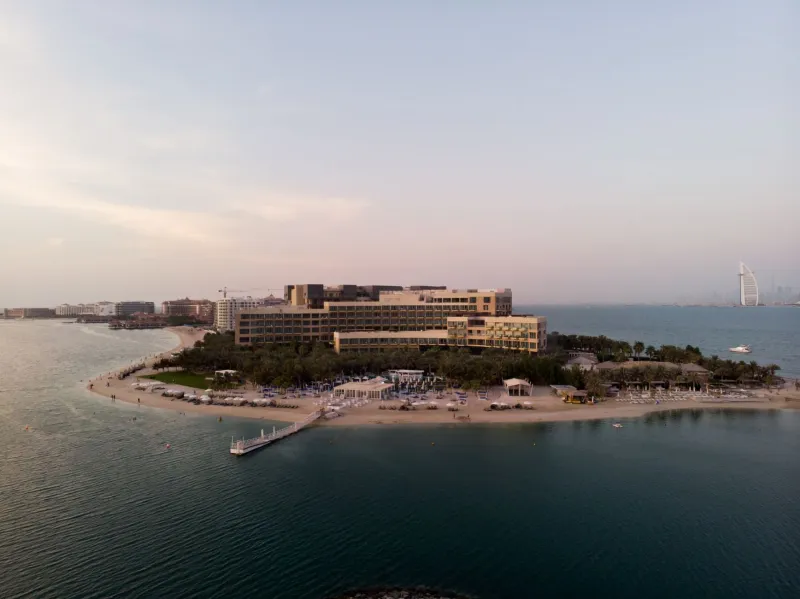
Changing Minds, One Island at a Time: How Al Marjan Is Transforming American Attitudes Toward Arabian Luxury
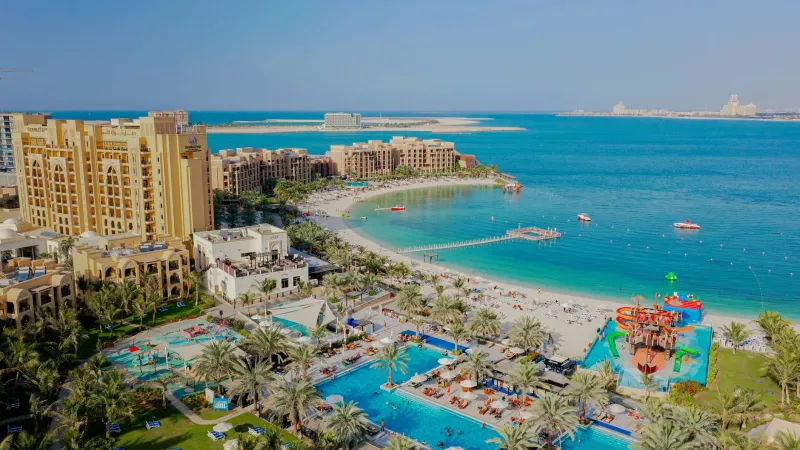
There is a particular moment that luxury travel consultants across the United States have begun to describe with striking consistency. It occurs not during the booking conversation, not during the flight, but somewhere on the causeway connecting Al Marjan Island to the Ras Al Khaimah mainland — when the Arabian Gulf appears on both sides of the vehicle, the resort towers catch the late-afternoon light, and the traveler who spent three months deliberating over whether to come at all falls suddenly, completely silent.
"That silence tells me everything," says one New York–based luxury travel advisor who has been routing high-net-worth clients to Al Marjan Island since 2022. "It's the moment the preconceptions dissolve. After that, I never have to work hard to get them back."
The transformation she describes is not incidental. It is, increasingly, the defining characteristic of the Al Marjan Island experience for American visitors — and it is reshaping, in measurable and meaningful ways, how affluent travelers from the United States think about the Middle East as a luxury destination.
The Weight of Outdated Assumptions
To appreciate the scale of the shift, one must first acknowledge what American travelers were working against. For much of the past two decades, the Middle East occupied an uncomfortable position in the US cultural imagination — a region defined more by geopolitical headlines than by its extraordinary hospitality traditions, architectural ambition, or natural beauty. Even among seasoned luxury travelers who had explored Southeast Asia, the South Pacific, and sub-Saharan Africa with confidence, the Arabian Gulf frequently remained unvisited, held at arm's length by a fog of vague unfamiliarity.
Ras Al Khaimah, the northernmost emirate of the UAE, was doubly obscured — not only by regional assumptions but by the longer shadow cast by Dubai, its more globally prominent neighbor. Al Marjan Island, an archipelago of four coral-shaped islands extending into the Gulf from the emirate's coastline, was, for most American travelers, simply unknown.
The data, however, is beginning to tell a different story.
Luxury travel agencies that track booking patterns among US clients with annual household incomes exceeding $500,000 have reported a marked increase in Gulf-region inquiries since 2022, with Ras Al Khaimah — and Al Marjan Island specifically — emerging as the fastest-growing sub-destination within that category. More telling than raw numbers is the profile of the traveler making those inquiries: not first-time international visitors, but experienced globetrotters who have, in many cases, already visited the Maldives, the Amalfi Coast, and Bora Bora, and who are actively seeking something they have not yet encountered.
What Al Marjan Actually Offers
The island's appeal is not reducible to a single amenity or attribute. Rather, it operates through a combination of elements that, taken together, produce an experience that is genuinely difficult to replicate elsewhere.
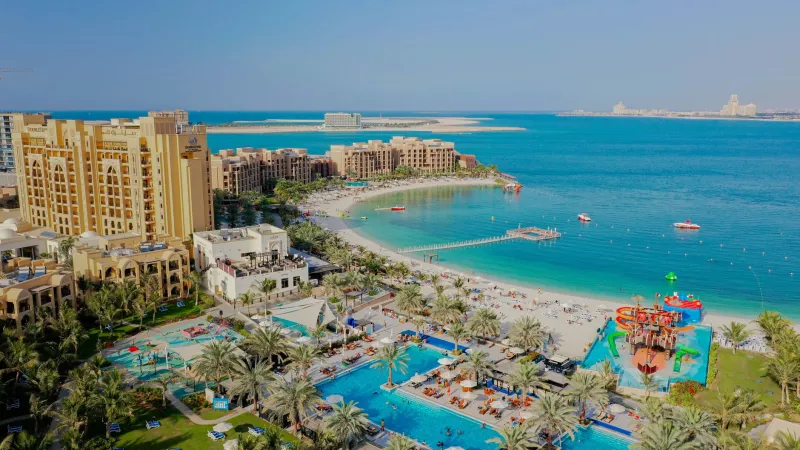
The physical setting is a natural beginning. Al Marjan Island's coastline encompasses miles of white-sand beaches facing the warm, calm waters of the Arabian Gulf — conditions that rival, and in some respects surpass, more celebrated tropical destinations. The climate, particularly between October and April, delivers consistent sunshine with low humidity and temperatures that allow for outdoor dining, watersports, and beach leisure without the oppressive heat that characterizes summer in many competing Gulf destinations.
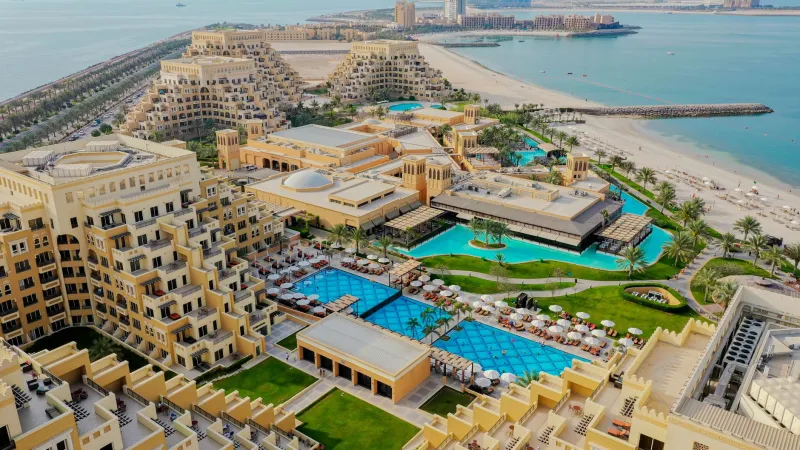
The resort infrastructure is equally compelling. Properties on Al Marjan Island have been developed with a level of architectural intentionality that surprises many first-time visitors. The interiors draw on traditional Emirati craft — intricate geometric tilework, hand-woven textiles, carved wood screens — while incorporating contemporary design principles that ensure spaces feel neither museological nor dated. The result is an aesthetic language that is authentically rooted in the region without sacrificing the comfort expectations of the American luxury traveler.
Perhaps most significant, however, is the hospitality itself. The UAE's service culture — attentive, anticipatory, and genuinely warm rather than transactionally polished — consistently registers as the element that most powerfully revises American visitors' expectations. "I came prepared to be impressed by the architecture," one traveler from Chicago recalled. "I was not prepared to feel genuinely welcomed. That distinction matters more than I expected."
The Role of Wynn Al Marjan Island
No discussion of the island's evolving global profile is complete without acknowledging the catalytic role of Wynn Al Marjan Island, the integrated resort development currently under construction and scheduled to open in 2027. The project — representing the first Wynn property outside of the United States, Macau, and Boston — carries considerable symbolic weight for American travelers.
For a segment of the US market, the Wynn name functions as a cognitive bridge: a trusted reference point that makes the unfamiliar feel accessible. Luxury travel consultants note that inquiries about Al Marjan Island increased meaningfully in the months following major Wynn Al Marjan Island announcements, suggesting that the project is actively expanding the island's awareness footprint among Americans who might not otherwise have encountered it.
The development's scope — encompassing gaming facilities, multiple restaurant concepts, spa and wellness programming, and entertainment venues — signals to the US market that Al Marjan Island is not positioning itself as a niche destination but as a full-spectrum luxury resort environment capable of competing with the world's most celebrated integrated resorts.
Transformation Stories
The most persuasive evidence of the Al Marjan effect, however, is not statistical. It is anecdotal — and the anecdotes are remarkably consistent.
A couple from Houston, both in their early fifties, initially booked Al Marjan Island as a compromise destination after disagreeing over whether to return to the Maldives or try somewhere new. They arrived with moderate expectations and left, by their own account, having experienced something that recalibrated their understanding of what a luxury vacation could be. They have since returned twice.
A solo traveler from San Francisco, a technology executive accustomed to premium travel, chose Al Marjan Island on the recommendation of a colleague and arrived skeptical. The combination of the Gulf views, the quality of the spa programming, and the ease of day excursions into Ras Al Khaimah's mountain interior converted him into what he describes as "an unpaid ambassador" for the destination.
These stories are not outliers. They are, increasingly, the norm — and they are circulating through the networks of affluent American travelers with the particular velocity of word-of-mouth recommendations that carry genuine conviction.
A Destination That Earns Its Reputation
What distinguishes Al Marjan Island's growing reputation from mere marketing momentum is that it is grounded in substance. The island is not asking American travelers to revise their expectations downward or to accept inconvenience in exchange for novelty. It is offering an experience that stands on its own terms — one that happens, as a secondary consequence, to dismantle assumptions about the Middle East that were never particularly well-founded to begin with.
For the American luxury traveler willing to exchange the familiar for the genuinely extraordinary, Al Marjan Island is not a gamble. It is, as a growing number of its most enthusiastic advocates will attest, among the most rewarding decisions they have made in years of serious travel.
The silence on the causeway, it turns out, is only the beginning.