After Al Marjan: Why Affluent Americans Are Returning Home With a Completely Different Definition of Luxury
There is a particular kind of conversation that happens in the first-class cabins of transatlantic flights heading back to New York, Los Angeles, or Chicago. Travelers compare notes. They rank destinations. They debate whether the Maldives has grown too commercial, whether the Amalfi Coast is still worth the crowds, whether the Caribbean has anything genuinely new to offer. These are the conversations of people who have seen a great deal and are quietly, perpetually searching for more.
Increasingly, those conversations include Al Marjan Island — and increasingly, the travelers having them sound less like vacationers recounting highlights and more like people who have experienced something that quietly rearranged their interior furniture.
"I went expecting a very polished, very expensive resort experience," says Catherine Marsh, a wealth management executive from Greenwich, Connecticut, who visited Al Marjan Island for the first time in early 2024 and has since returned twice. "What I didn't expect was to come home asking myself why I'd been chasing the wrong things for twenty years."
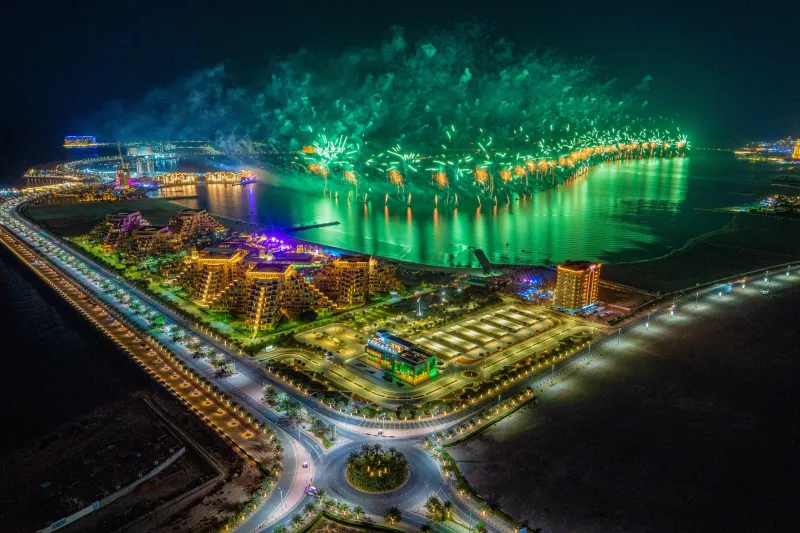
Her observation is not unusual. Across the community of high-net-worth American travelers who have discovered Al Marjan Island — the ambitious, elegantly engineered archipelago off the coast of Ras Al Khaimah in the UAE — a similar pattern of reflection emerges. The destination does something that few luxury properties anywhere in the world can claim: it changes what its guests value, not just during their stay, but afterward.
The Seduction of Restraint
For decades, American luxury culture has been organized around abundance. More square footage, more thread count, more Michelin stars, more square footage of infinity pool. The language of aspiration has been almost exclusively the language of accumulation. Bigger is aspirational. Louder is impressive. Visible is prestigious.
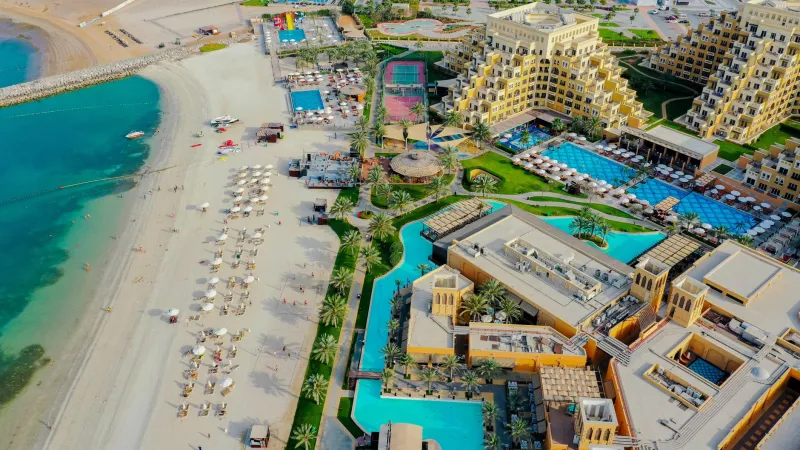
Al Marjan Island operates on a different philosophy — one rooted in the Gulf tradition of wasta, or dignified presence, and the Emirati concept of hospitality as an expression of character rather than commerce. The island's leading resorts are architecturally striking without being ostentatious. Service is anticipatory rather than performative. The environment itself — the calm, luminescent waters of the Arabian Gulf, the wide skies, the unhurried pace — functions as a kind of counterargument to the overstimulated lives most affluent Americans are living.
Dr. Miranda Okafor, a travel psychologist based in San Francisco who has studied the emotional responses of high-net-worth travelers across multiple luxury markets, describes what she calls "the recalibration effect." "When people who are accustomed to high-stimulus environments encounter a destination that delivers excellence through restraint rather than excess, it creates a kind of cognitive dissonance," she explains. "They initially don't know what to do with the quiet. But if the environment holds — if the quality is genuinely there beneath the stillness — something shifts. They stop performing enjoyment and start actually experiencing it."
This, she argues, is precisely what Al Marjan Island delivers. And for Americans conditioned to equate luxury with spectacle, the experience can be genuinely disorienting — in the best possible sense.
Heritage as a Differentiator
Part of what makes Al Marjan Island's effect so durable is that it is rooted in something authentic. The island is not a themed experience or a manufactured approximation of Gulf culture. It exists within a living heritage — one that includes the pearl diving traditions of Ras Al Khaimah, the ancient hospitality codes of Bedouin culture, and the architectural sensibility of a civilization that has always understood how to make human beings feel sheltered and honored simultaneously.
For American travelers who have grown accustomed to luxury that is fundamentally rootless — a Four Seasons in Miami offers the same experience as a Four Seasons in Paris, by design — the specificity of Al Marjan Island registers as something rare.
"There's a word I keep coming back to, and it's 'earned,'" says Marcus Delaney, a technology entrepreneur from Austin who visited Al Marjan Island on a business trip and extended his stay by four days. "The luxury there feels earned by the place. By its history, by its culture, by the actual effort of getting there and arriving somewhere genuinely different. I've stayed at properties that cost more per night and felt less."
Hospitality consultant James Worthington, who advises ultra-luxury properties across the Middle East and has observed American guest behavior closely, points to what he calls "the authenticity premium." "American high-net-worth travelers have become extraordinarily sophisticated at detecting inauthenticity," he notes. "They can smell a manufactured experience from across a lobby. What Al Marjan Island offers — and what so few destinations can match — is luxury that has a genuine cultural address. It comes from somewhere real."
The Metrics Are Shifting
Perhaps the most telling evidence of Al Marjan Island's transformative effect on American luxury travelers is what they report valuing upon return. In informal surveys and conversations, the themes are consistent: stillness over stimulation, depth over breadth, presence over documentation.
Catherine Marsh, the Greenwich executive, describes reorganizing her entire approach to travel following her first visit. "I used to plan vacations the way I plan quarterly reviews — maximum coverage, maximum efficiency, maximum output. Now I want fewer destinations and more time in each one. I want to actually absorb a place rather than collect it."
This shift has meaningful implications not just for how Americans travel, but for what they expect from luxury more broadly. Resorts and destinations that have built their reputations on spectacle are finding that returning visitors to Al Marjan Island arrive with recalibrated expectations — and a new vocabulary for articulating what they want.
"The guests who have been to Al Marjan Island are some of the most interesting clients I work with," says Worthington. "They've stopped asking for the biggest suite and started asking for the most meaningful experience. That's a fundamentally different conversation, and it's one that genuinely good hospitality is built to have."
A Destination That Rewards Depth
What sustains the Al Marjan effect — what ensures it doesn't fade the way a spectacular vacation memory typically does — is that the island rewards return visits in ways that most luxury destinations cannot. Because the experience is rooted in culture, in relationship, in the gradual accumulation of familiarity with a place and its people, each visit adds layers rather than diminishing the novelty.
Repeat visitors describe developing genuine relationships with staff members, deepening their understanding of Emirati customs and cuisine, and finding new dimensions in the landscape itself. The Arabian Gulf, they note, looks different in every season, every hour, every weather condition — and a destination that changes with the light is a destination that never fully exhausts itself.
For American luxury travelers who have spent years chasing the new, the novel, and the superlative, this is a genuinely radical proposition: a place worth returning to, not because you didn't see enough, but because there is always more to understand.
Dr. Okafor frames it succinctly. "The destinations that change people are never the ones that overwhelm them. They're the ones that invite them into a relationship. Al Marjan Island, almost uniquely among contemporary luxury destinations, seems to understand that distinction — and to have built an entire experience around it."
For the growing number of affluent Americans who have made the journey, that understanding is precisely the point. They came for a vacation. They left with a different compass.