One Week on the Gulf: The Surprising Science of How Al Marjan Island Permanently Alters Your Relationship With Time
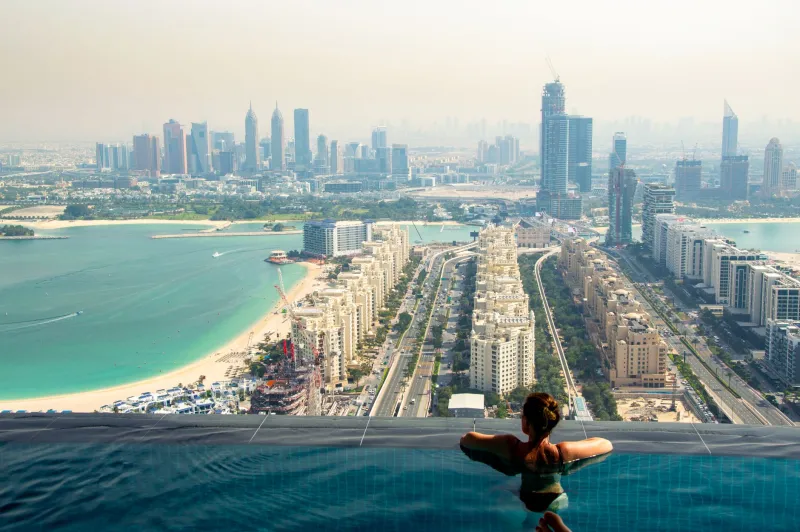
Something unusual tends to happen to American travelers around the third day of a stay at Al Marjan Island. The compulsive glance at the wrist watch softens. The instinct to fill every hour with scheduled activity begins to loosen. A different kind of awareness takes hold—one oriented not by the clock, but by the quality of the light on the water, the pace of a meal, the unhurried arc of an afternoon. For many guests, this shift feels unfamiliar. For some, it feels, for the first time in years, like relief.
What's actually happening in the brain during this transition is a subject of growing interest among researchers who study the neuroscience of luxury environments and restorative travel. And what they're finding suggests that Al Marjan Island—through a combination of deliberate design, environmental immersion, and rhythmic pacing—may be doing something genuinely measurable to the way its guests experience time.
The American Relationship With Time: A Problem Worth Solving
To understand why Al Marjan Island produces such pronounced effects, it helps to first understand what most high-achieving Americans bring with them when they travel. Studies consistently show that affluent professionals in the United States operate under conditions of chronic time scarcity—a psychological state in which the perception of too little time generates cognitive stress comparable to financial anxiety. This isn't simply a matter of being busy. It is a deeply ingrained orientation toward time as a resource that is always depleting, always under threat.
This orientation doesn't vanish the moment a traveler boards a plane. In fact, research into vacation behavior among high-net-worth individuals reveals that the first two days of any trip are often dominated by residual cognitive load: the mental chatter of unfinished tasks, the background hum of professional obligations, the habitual monitoring of digital devices. True psychological disengagement, for many, arrives late—or not at all.
Al Marjan Island appears to accelerate and deepen that disengagement in ways that more conventional luxury destinations do not.
Architecture as a Temporal Cue
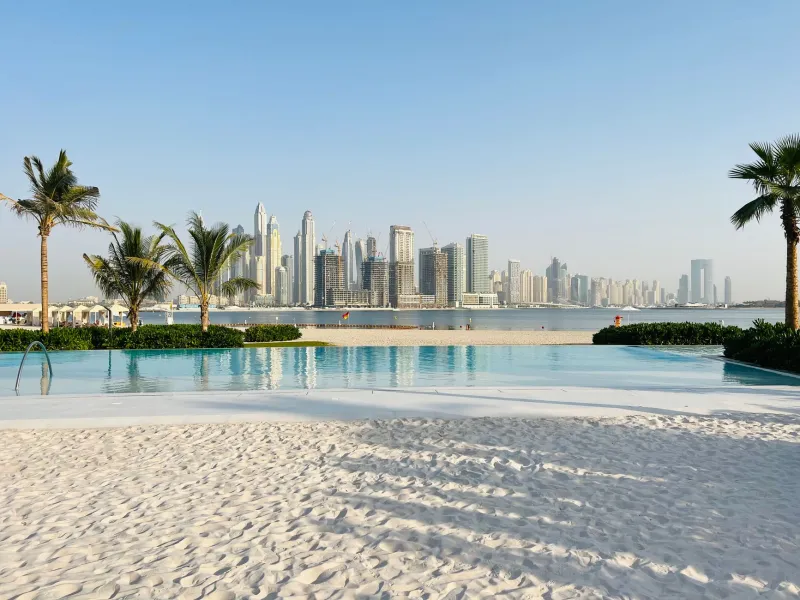
One of the most compelling explanations lies in the built environment itself. The resort architecture at Al Marjan Island is characterized by expansive sightlines, an abundance of natural light, and a pervasive orientation toward the Arabian Gulf. These are not merely aesthetic choices. Cognitive scientists have long understood that environments with broad visual horizons activate what is sometimes called the default mode network—a set of brain regions associated with mind-wandering, self-reflection, and the perception of time as abundant rather than scarce.
When the eye is given space to travel—across water, toward a horizon, through an open-air corridor that frames the sky—the brain interprets this spatial generosity as temporal generosity. Time, neurologically speaking, begins to feel like something you have rather than something you're losing.
The deliberate use of natural materials, the integration of water features, and the absence of the visual noise that characterizes most urban luxury environments compound this effect. Guests aren't simply relaxing. They are, in a measurable neurological sense, recalibrating.
Circadian Rhythm and the Gulf's Particular Light
The Arabian Gulf's geography offers another advantage that is easy to overlook: its light. Ras Al Khaimah's position along the Gulf provides a quality of natural illumination that is distinct in its warmth and clarity, particularly in the cooler months that attract the largest share of American visitors. This matters more than it might initially seem.
Circadian rhythm—the internal biological clock that governs sleep, alertness, mood, and metabolic function—is exquisitely sensitive to light exposure. Americans traveling from the East Coast or West Coast arrive with circadian systems already under strain from time zone displacement and the chronic light disruption of indoor professional life. Exposure to the Gulf's particular quality of morning and evening light, especially when paired with the outdoor orientation that Al Marjan Island's design encourages, has a genuine regulatory effect on these systems.
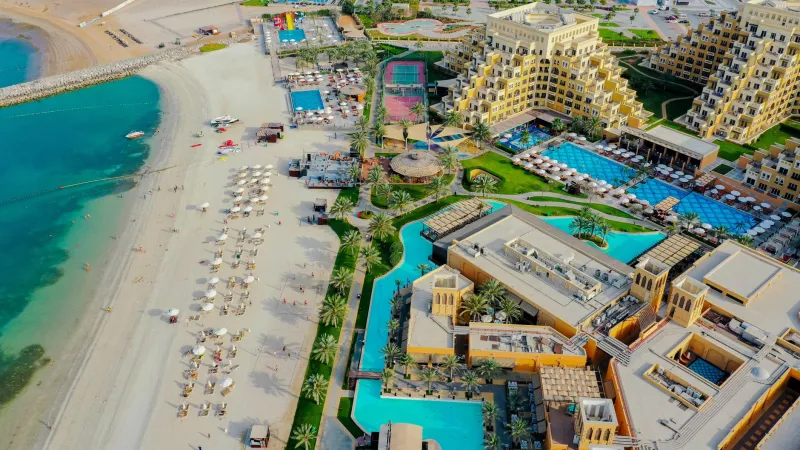
Guests who spend significant portions of their day outdoors—on private terraces, at beachfront dining venues, along the waterfront promenade—are effectively resetting their biological clocks. Sleep improves. The distinction between day and night sharpens. And with that sharpening comes something that sleep researchers describe as temporal richness: the subjective sense that each hour contains more experience, more texture, more value.
The Pace of Intentional Luxury
Beyond architecture and light, there is the matter of pace. Al Marjan Island's resort culture is calibrated to move at a rhythm that is genuinely different from what most Americans encounter in their daily lives—or, for that matter, in most luxury travel environments.
Service here is attentive without being intrusive. Meals unfold across time rather than being efficiently concluded. Experiences—whether a sunset dhow cruise, a spa treatment, or a private beach arrangement—are structured to resist acceleration. This is not inefficiency. It is, in the language of behavioral economics, a form of temporal reframing: an environmental insistence that the present moment is worth inhabiting fully.
For guests accustomed to optimizing every hour, this initial resistance can feel mildly uncomfortable. But the discomfort is brief. Within days, most visitors begin to internalize the pace, and with that internalization comes a shift in how they evaluate their own time. Hours that would previously have been judged as unproductive—a long lunch, an unscheduled afternoon, a slow walk along the shoreline—begin to register as genuinely valuable.
What Guests Carry Home
Perhaps the most remarkable aspect of the Al Marjan Island experience is what persists after departure. Surveys and anecdotal accounts from returning American guests reveal a consistent pattern: the changes in time perception initiated on the island do not simply evaporate upon reentry into professional life. Many guests report restructuring their schedules in the months following a visit—protecting mornings, reducing meeting density, creating deliberate pauses in their days that mirror the rhythms they encountered on the Gulf.
Behavioral psychologists refer to this phenomenon as schema updating: the process by which a sufficiently powerful experience rewrites the cognitive frameworks through which we interpret subsequent reality. Al Marjan Island, it appears, is powerful enough to do exactly that.
This is the deeper promise of what this destination offers—not merely a week of exceptional comfort, but a genuine reconfiguration of the values and habits that govern how its guests relate to their own lives. In a culture that has elevated busyness to a status symbol, that is a genuinely subversive gift.
A Different Kind of Return on Investment
For the American traveler who measures the value of every expenditure, including travel, the Al Marjan Island experience presents a compelling case. The return on investment here is not calculated in itinerary items checked off or Instagram content generated. It is measured in the quality of attention brought to the hours that follow—in the weeks and months of a life lived with greater intentionality, clarity, and presence.
That is, ultimately, what a week on the Arabian Gulf offers the discerning American traveler: not an escape from time, but a profoundly different understanding of what time is actually for.