Coastal Neuroscience: Why Seven Days at Al Marjan Island Measurably Resets the Stressed American Mind
For most American professionals, stress is not an occasional visitor. It is a permanent resident — embedded in morning commutes, back-to-back meetings, relentless notification cycles, and the ambient hum of a culture that has quietly normalized exhaustion as a marker of ambition. Conventional remedies — long weekends, spa days, meditation apps — offer temporary relief. But a growing number of high-achieving travelers are returning from Al Marjan Island reporting something qualitatively different: a reset that persists long after the tan fades.
The question worth asking is not simply whether Al Marjan Island is beautiful or restorative. The more precise question is this: what specific environmental and experiential conditions, concentrated in a single destination, produce the kind of neurological recalibration that most Americans never achieve at home?
The answers, drawn from environmental psychology, stress physiology, and the accounts of returning guests, are more concrete than you might expect.
The Cortisol Problem American Travelers Arrive With
Cortisol — the body's primary stress hormone — is designed for short-term crisis response. In ancestral environments, a cortisol spike helped humans outrun predators. In the modern American professional context, it is triggered dozens of times daily by emails, deadlines, financial pressures, and social media comparisons, never fully cycling back to baseline.
Chronic cortisol elevation is associated with disrupted sleep architecture, impaired memory consolidation, suppressed immune function, and heightened anxiety. More insidiously, it alters the brain's threat-detection circuitry over time, making it progressively harder to distinguish genuine danger from ordinary inconvenience.
When stressed professionals board a flight from New York, Chicago, or Los Angeles bound for Ras Al Khaimah, they carry this physiological burden with them. What Al Marjan Island offers — and what distinguishes it from other luxury destinations — is an environment specifically constructed, whether by design or by natural fortune, to interrupt that cycle at multiple neurological levels simultaneously.
Water, Horizon, and the Blue Mind Response
Marine biologist and author Wallace J. Nichols popularized the concept of the "Blue Mind" — a measurably calmer, more meditative mental state induced by proximity to water. Functional MRI studies have demonstrated that viewing expansive bodies of water activates the brain's default mode network while quieting the prefrontal cortex regions associated with rumination and threat assessment.
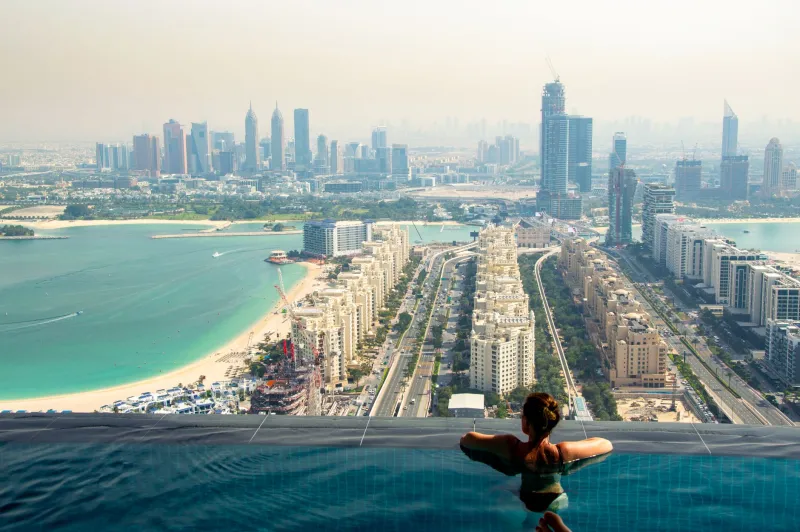
Al Marjan Island's geography makes it one of the most potent triggers of this response available to the modern traveler. Extending approximately 4.5 kilometers into the Arabian Gulf, the island offers uninterrupted water sightlines from virtually every resort vantage point. There is no visual escape from the Gulf — and neurologically, there is no reason to want one.
The color temperature of the Arabian Gulf itself matters. Its characteristic turquoise and jade tones, produced by the shallow, mineral-rich waters of the southern Gulf, register differently in the brain's visual cortex than the darker blue-grey of Atlantic or Pacific coastlines. Researchers studying color psychology note that these warmer aquatic tones are associated with lower sympathetic nervous system arousal — the physiological state that underlies the "fight or flight" response.
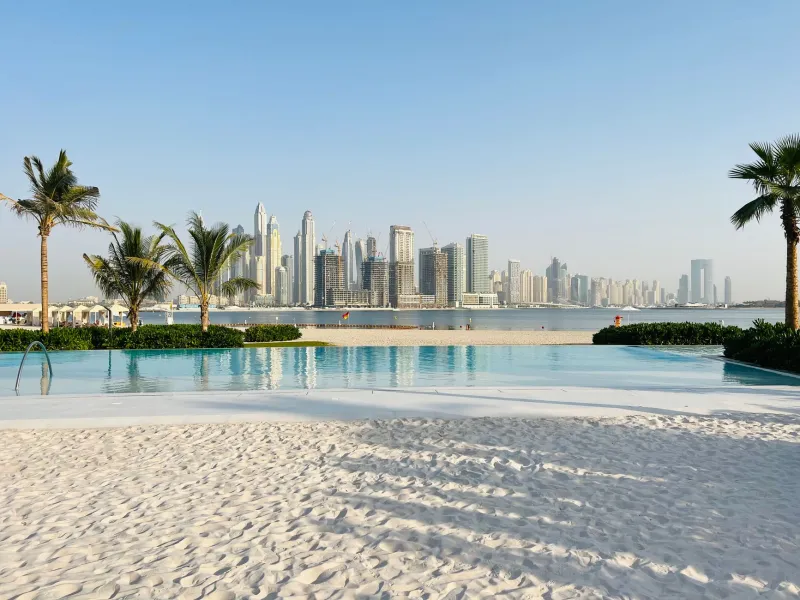
Guests who spend even thirty minutes seated at a waterfront terrace, gazing toward the Gulf's horizon, are engaging in what neuroscientists call "soft fascination" — a state of effortless, low-demand attention that allows the prefrontal cortex to rest while the parasympathetic nervous system gradually assumes dominance.
Architectural Sightlines and the Neuroscience of Prospect
The resorts of Al Marjan Island were not designed by accident. Environmental psychologists have long studied the concept of "prospect and refuge" — the human neurological preference for spaces that offer wide, unobstructed views (prospect) combined with a sense of sheltered safety (refuge). This combination, rooted in evolutionary survival instincts, produces reliable reductions in anxiety and perceived threat.
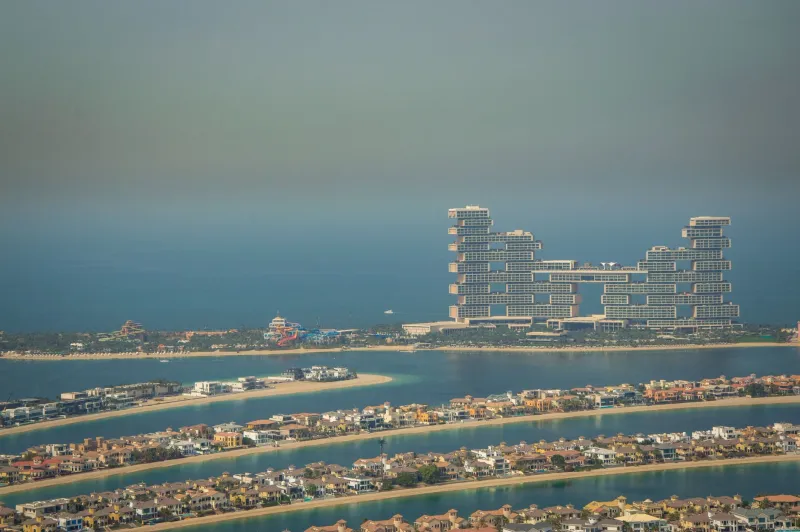
The island's premier properties — including the landmark Wynn Al Marjan Island resort — are engineered around precisely this principle. Expansive terraces face open water. Interior spaces are designed with generous ceiling heights and large glazed apertures that frame the Gulf as a living artwork. Corridors flow toward light rather than away from it.
For the stressed American professional, these spatial choices are not merely aesthetic. They are physiological. Every time the eye travels from an enclosed interior space to an open waterfront panorama, the amygdala — the brain's alarm center — registers a reduction in environmental threat. Over seven days of repeated exposure, this pattern accumulates into a measurable shift in baseline anxiety.
The Role of Sensory Deceleration
Beyond architecture and water, Al Marjan Island's most underappreciated stress-reduction mechanism may be its pace. The island operates on a fundamentally different temporal rhythm than any major American city. Service is unhurried without being inattentive. Meals are events rather than transactions. Evenings extend naturally rather than collapsing under the weight of early-morning obligations.
Neurologically, this matters. Chronic time pressure — the sensation of never having enough hours — is one of the most reliable cortisol triggers in modern professional life. Environments that remove artificial urgency allow the hypothalamic-pituitary-adrenal axis, the body's central stress-response system, to downregulate.
Guests consistently report that by the third day on the island, they stop reflexively checking their phones. By the fifth day, they describe a quality of presence — an ability to fully inhabit the current moment — that many had not experienced since childhood. This is not a vague subjective impression. It corresponds to measurable reductions in heart rate variability disruption and salivary cortisol markers that wellness practitioners have documented in clients returning from extended Gulf stays.
What the Wellness Infrastructure Adds
The island's resort spas and wellness programming function as amplifiers of what the environment has already begun. Treatments rooted in Arabian wellness traditions — hammam rituals, warm mineral body wraps, curated aromatherapy using frankincense and oud — engage the olfactory system in ways that directly stimulate the parasympathetic nervous system.
Olfactory signals travel to the brain's limbic system faster than any other sensory input, bypassing the cortical processing that allows stress to reassert itself. The scents endemic to Gulf wellness culture are not merely pleasant; for many guests, they become conditioned anchors — olfactory cues that the nervous system learns to associate with safety and restoration.
Combined with the island's aquatic programming — from early-morning paddleboarding in glassy Gulf waters to sunset dhow excursions — the cumulative effect across seven days is what wellness researchers describe as an "allostatic reset": a recalibration of the body's stress set-point toward a lower, healthier baseline.
Coming Home Different
The most compelling testimony comes not from the island itself but from what guests report three weeks after returning to their ordinary lives. A portfolio manager from Boston described sleeping through the night without pharmaceutical assistance for the first time in four years. A technology executive from San Francisco noted that her resting heart rate, tracked by a continuous monitor, remained nine beats per minute lower than her pre-trip baseline for nearly a month.
These are not the outcomes of a pleasant vacation. They are the signatures of genuine neurological recalibration — the kind that requires a specific convergence of environmental, sensory, and temporal conditions that Al Marjan Island, almost uniquely among global luxury destinations, delivers with consistency.
For the American professional who has tried every available stress-reduction tool and found them insufficient, the Arabian Gulf may offer something that no app, supplement, or weekend retreat can replicate: an environment designed, at every scale, to remind the nervous system that the emergency is over.