Built to Breathe: The Neuroscience Behind Al Marjan Island's Profoundly Calming Architecture
For the average American professional arriving at Al Marjan Island after a transcontinental flight and months of relentless urban pressure, the sensation is almost disorienting. Within hours — sometimes within minutes — something fundamental shifts. The jaw unclenches. The shoulders descend. The internal monologue quiets. Many guests describe it as arriving somewhere they did not realize they had been looking for.
This is not coincidence, nor is it merely the novelty of a new destination. The physical environment of Al Marjan Island has been designed — whether by deliberate intention or through the accumulated wisdom of its architects — to speak directly to the human nervous system. And increasingly, neuroscience has the vocabulary to explain exactly what is being said.
The Nervous System as the True Guest
To understand why Al Marjan Island feels the way it does, it helps to understand the basic architecture of human stress. The autonomic nervous system operates in two primary modes: the sympathetic state, colloquially known as "fight or flight," and the parasympathetic state, often called "rest and digest." Most Americans living in major metropolitan areas — New York, Los Angeles, Chicago, Miami — spend a disproportionate share of their daily lives in some degree of sympathetic activation. Traffic, notifications, ambient noise, artificial lighting, and the sheer density of urban environments keep the nervous system in a state of low-grade alert.
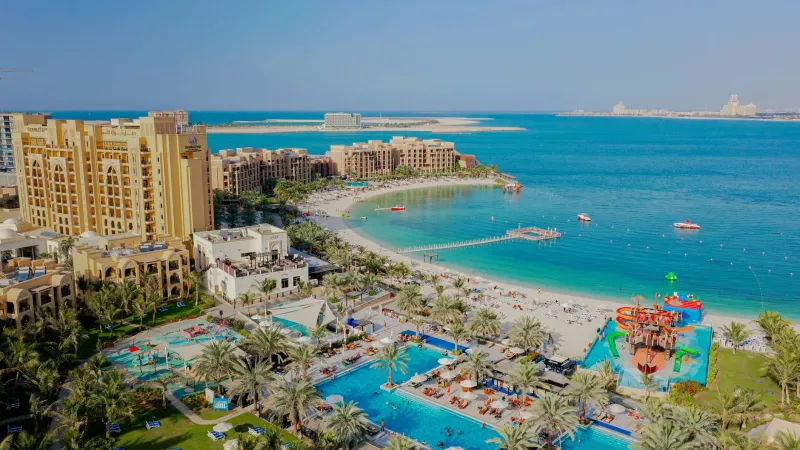
Luxury travel, at its most meaningful, is not simply about thread counts and champagne service. It is about creating the precise environmental conditions under which the parasympathetic nervous system can finally assert itself. Al Marjan Island, situated on four interconnected man-made islands extending into the warm, shallow waters of the Arabian Gulf in Ras Al Khaimah, UAE, accomplishes this through a convergence of design principles that modern neuroscience is only beginning to fully codify.
Water as a Neurological Reset Button
Perhaps no single element of Al Marjan Island's environment does more neurological work than water. The island is, by definition, surrounded by it — and that proximity is not incidental to the experience of calm. Research in environmental psychology has consistently demonstrated that proximity to water, what marine biologist Dr. Wallace J. Nichols famously termed the "Blue Mind" state, induces measurable reductions in cortisol, the primary stress hormone, while increasing serotonin and dopamine activity.
The Arabian Gulf here is unusually calm. Its waters are shallow, warm, and luminously clear, with a color palette ranging from pale jade to deep turquoise depending on the time of day. Unlike the churning Atlantic coastlines familiar to many East Coast Americans, or the powerful Pacific swells of the West, the Gulf presents water in its most psychologically accessible form: still, reflective, and non-threatening. The visual processing centers of the brain register this stillness and communicate safety to the limbic system — the emotional core of the brain — triggering a cascade of parasympathetic responses.
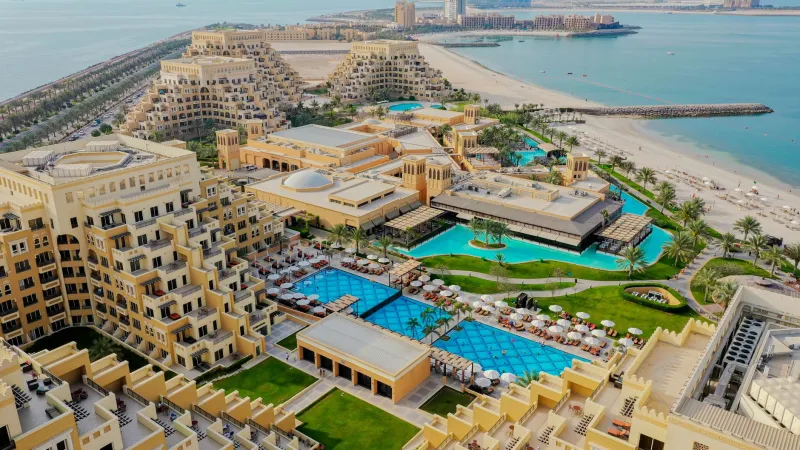
Al Marjan Island's resorts amplify this effect by positioning infinity pools, open-air lounging decks, and dining terraces in direct visual dialogue with the water. The horizon is never obscured. The eye is perpetually invited outward, away from the enclosed, screen-dominated visual field that characterizes most American daily experience.
The Geometry of Calm
Beyond water, the spatial geometry of Al Marjan Island's resort architecture plays a role that is easy to overlook but impossible to overstate. Neuroscientists and environmental psychologists have long studied the relationship between spatial configuration and psychological state. Environments dominated by sharp angles, vertical compression, and visual clutter — the grammar of most American office buildings and urban streetscapes — activate vigilance responses in the brain. Environments characterized by open sightlines, gentle curves, horizontal orientation, and visual breathing room do the opposite.
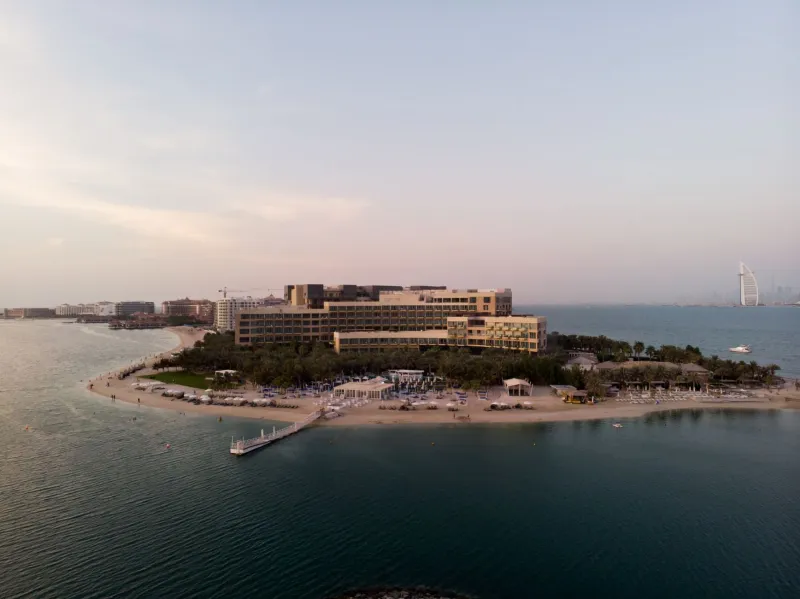
The resort properties along Al Marjan Island's coastline are almost uniformly low-rise and horizontally expansive. Buildings rarely compete with the sky. Corridors open into courtyards. Guest suites are oriented toward the water rather than inward toward hotel infrastructure. The visual field, at nearly every turn, is permitted to exhale.
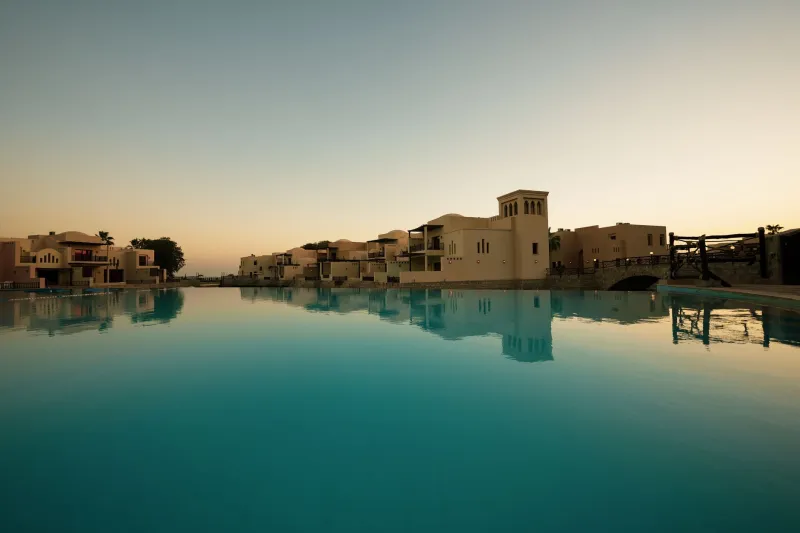
Color, too, is doing significant neurological work. The dominant palette of Al Marjan Island — warm sand tones, bleached whites, soft terracottas, and the ever-present blue-green of the Gulf — aligns closely with what color psychology research identifies as the most reliably calming range of the visual spectrum. These are not arbitrary aesthetic choices. They are, in effect, a form of environmental medication.
Acoustic Design and the Silence Beneath the Surface
For American visitors accustomed to the sonic density of city life, one of the most immediately striking qualities of Al Marjan Island is its relative quiet. This is partly geographical — the island sits apart from the urban core of Ras Al Khaimah, insulated from traffic and commercial noise. But it is also architectural.
Many of the island's resort properties incorporate design elements that manage acoustic environments with the same precision applied to visual ones. Open-air construction allows natural breezes to carry sound away rather than bounce it between hard surfaces. Water features — fountains, reflecting pools, the gentle rhythm of Gulf waves — provide what acoustic designers call "pink noise," a naturally occurring sound frequency that the brain processes as non-threatening background information, effectively masking intrusive sounds and reducing auditory vigilance.
Wellness practitioners who work with guests at Al Marjan Island's resort spas consistently note that acoustic calm is among the first things visitors remark upon. "People arrive from New York or Dallas and they say the silence feels almost strange at first," one spa director observed. "Within a day, that strangeness becomes the thing they are most reluctant to leave behind."
Thermal Comfort and the Relaxed Body
The climate of Ras Al Khaimah, while warm, offers something that many American visitors find unexpectedly therapeutic: consistent warmth without the humidity extremes of, say, Southeast Asia or the Florida Keys in summer. The Arabian Gulf's dry warmth, particularly in the shoulder seasons of October through April, allows the body to remain comfortably warm without the physiological cost of excessive sweating or thermoregulatory stress.
Research in thermal comfort has demonstrated that the body's parasympathetic nervous system is most accessible when core body temperature is gently elevated — warm enough to relax musculature and dilate peripheral blood vessels, but not so hot as to trigger heat-stress responses. The climate of Al Marjan Island during its prime travel season sits, for many visitors, in precisely this optimal range.
What Guests Actually Experience
The neurological theory is compelling, but the human testimony is perhaps more persuasive. Guests from American cities regularly describe their time at Al Marjan Island in language that goes well beyond conventional travel satisfaction. Words like "transformed," "recalibrated," and "reset" appear with striking frequency in guest accounts. One couple from Chicago described returning home after a week at a Gulf-facing resort suite and feeling, for the first time in years, that they were capable of genuine rest — not just sleep, but the deeper restorative state that sleep is supposed to provide.
This is the promise that Al Marjan Island makes, and largely keeps: not merely a beautiful place to visit, but an environment calibrated, at a level below conscious awareness, to restore something that modern American life steadily depletes.
Designing the Future of Luxury Recovery
As the global luxury travel market increasingly recognizes that the most valuable commodity it can offer is not opulence but genuine restoration, Al Marjan Island occupies a uniquely advantageous position. Its natural assets — the Gulf, the light, the quiet — provide a foundation that no amount of interior design can fully replicate. Its architectural sensibility builds on that foundation with intelligence and restraint.
For the American traveler who has begun to suspect that what they need is not simply a vacation but a genuine neurological recalibration, Al Marjan Island offers something rare: a destination that understands the science of serenity well enough to deliver it reliably, beautifully, and completely.