The Productive Power of Emptiness: What Al Marjan Island Reveals About the Science of Strategic Rest
For most American executives, the word "itinerary" functions less as a travel tool and more as a psychological security blanket. Fill every hour. Schedule the sunrise yoga, the afternoon boat excursion, the curated dining reservation. Return home exhausted but justified—at least the trip was productive.
Al Marjan Island, the sweeping man-made archipelago extending into the Arabian Gulf off the coast of Ras Al Khaimah, is quietly dismantling that compulsion. And the results, according to those who have surrendered to its particular brand of unhurried luxury, are measurably transformative.
The Problem With Being Perpetually Busy
The United States has a well-documented productivity paradox: its professionals work longer hours than nearly any other developed nation, yet research from institutions including Harvard Business School consistently demonstrates diminishing cognitive returns after sustained periods of high-intensity effort. The prefrontal cortex—the brain's executive center, responsible for strategic thinking, nuanced judgment, and creative synthesis—does not simply slow down under chronic stress. It begins to malfunction.
Dr. Marcus Leighton, a cognitive neuroscientist whose work focuses on high-performance populations, puts it plainly: "The executives who arrive at a destination and immediately reach for their phones, who book every hour with activities, who cannot tolerate ambiguity in their schedule—these are the individuals whose brains are most desperately signaling a need for genuine rest. The irony is that their busyness prevents them from receiving it."
What the brain actually requires, Leighton explains, is activation of what researchers call the default mode network—a constellation of neural regions that becomes most active not during focused tasks, but during periods of apparent mental vacancy. Daydreaming. Idle gazing at a horizon. The unhurried consumption of a meal eaten without distraction. These states, far from representing cognitive waste, are precisely when the brain consolidates memory, generates novel connections between disparate ideas, and processes unresolved emotional material.
The challenge, for most Americans, is finding an environment that actually permits this state to occur.
Designing for Vacancy
This is where Al Marjan Island enters the conversation in a manner that distinguishes it from virtually every other luxury destination competing for the American traveler's attention.
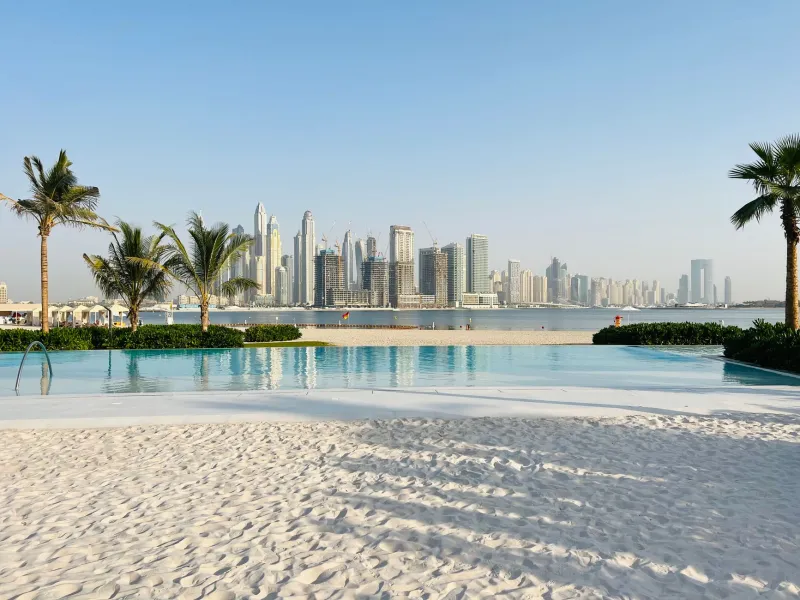
The island's resort properties—among them the landmark Wynn Al Marjan Island, currently among the most anticipated hospitality openings in the region—were not designed merely to impress. They were designed, with considerable intentionality, to slow. Wide corridors that open unexpectedly onto Gulf vistas. Pools positioned to face the precise angle of the afternoon sun as it descends toward the Hajar Mountains. Lounging areas where the architecture itself discourages the instinct to reach for a device.
"We speak often in hospitality about creating experiences," notes one senior design consultant who contributed to multiple Al Marjan properties and spoke on background. "What we discuss less frequently is creating absences—the deliberate removal of stimulation, of obligation, of the subtle environmental cues that keep a guest in an activated, task-oriented state. The most sophisticated thing a luxury environment can do is give a guest permission to stop."
This philosophy manifests in details that reveal themselves slowly: the absence of televisions in certain outdoor spaces, the deliberate distance between sun loungers that precludes casual conversation and encourages solitary contemplation, the way certain pathways meander without apparent purpose, inviting the kind of aimless walking that neuroscientists have linked to elevated creative output.
What Happens When Nothing Happens
Americans who have spent extended time at Al Marjan Island without a structured agenda describe a remarkably consistent arc. The first day, often, is characterized by restlessness—a low-grade anxiety born of unscheduled hours and the habitual pull of professional obligation. By the second day, something begins to shift. By the third, many describe what can only be called cognitive unlocking.
Caroline Whitfield, a Chicago-based private equity partner who visited Al Marjan Island for the first time in early 2024, recalls the experience with the slightly bewildered candor of someone still processing its implications. "I brought three strategy documents I intended to review. I opened my laptop exactly once, on the first afternoon, and then closed it and didn't return to it. Not because I made a noble decision to unplug—I genuinely forgot. The environment simply didn't support that version of myself."
She returned to her firm, she says, and within two weeks had resolved a deal structure that had stalled for months. "I'm not crediting the Gulf air," she adds with a measured smile. "But I am crediting the absence of noise—internal and external—that I hadn't experienced in years."
This is the counterintuitive promise of strategic idleness: not that rest replaces work, but that it restores the cognitive infrastructure upon which genuinely excellent work depends.
The Gulf as Contemplative Landscape
There is something specific about Al Marjan Island's physical context that warrants attention beyond its architectural merits. The Arabian Gulf, at this latitude and in this light, is not a dramatic ocean. It does not demand attention the way the Atlantic does, or provoke awe the way the Pacific can. It is, in the most generous sense of the word, mild—its warm, shallow waters moving with a gentleness that functions almost as an environmental sedative.
Psychologists who study the restorative effects of natural environments have long noted that bodies of water exert a disproportionate calming influence on the human nervous system. The Gulf's particular character—its color shifting from pale turquoise to deep jade across the day, its horizon unmarked by shipping lanes or distant landmass—provides what researchers term "soft fascination": a form of effortless, low-demand attention that allows the deeper mind to wander productively without conscious effort.
Combined with Ras Al Khaimah's exceptional air quality, its relative quiet compared to the intensity of Dubai, and the island's deliberate distance from urban overstimulation, Al Marjan offers an environment that is genuinely rare in the contemporary luxury landscape: one that does not compete for a guest's attention, but simply holds it, lightly.
Rethinking the Return on Investment
For the American executive accustomed to quantifying every expenditure—including the expenditure of time—Al Marjan Island invites a recalibration of what a successful trip actually yields. The traveler who returns home tanned but still depleted, who consumed every scheduled activity and photographed every curated moment, has perhaps missed the destination's most singular offering.
The traveler who spent three mornings doing absolutely nothing at the water's edge, who ate slowly and read fiction and allowed entire afternoons to dissolve without record or purpose—that traveler may have made the most strategically sound investment of their professional year.
The Gulf has been a place of commerce, contemplation, and cultural exchange for millennia. Al Marjan Island, in its contemporary form, extends that tradition in a direction that America's most driven professionals are only beginning to discover: the ancient, radical, and quietly revolutionary act of being entirely, luxuriously, productively still.